News
Latest updates from SpaceLab UFSC — mission milestones, partnerships, publications and events.
OESC scholarship selection — final results published
The final results of the OESC scholarship selection process have been published. The selection process for the 41 scholarships in the IC, DTI-B and DTI-A categories has been completed.
The selection is part of Edital SpaceLab/OESC No. 01/2026, linked to FAPESC Public Call No. 027/2026 — New Space.
OESC scholarship selection — documentary eligibility results published
The documentary eligibility stage of the OESC scholarship selection process has been completed. The official list of candidates eligible to proceed to the next stages is now available on the OESC website.
The selection is part of Edital SpaceLab/OESC No. 01/2026, linked to FAPESC Public Call No. 027/2026 — New Space.

SpaceLab/OESC opens 41 scholarship positions - Applications until September 30
SpaceLab/OESC has opened a selection process for 41 scholarships for the OESC - Santa Catarina Space Economy Observatory.
The opportunities include 20 undergraduate research (IC), 10 DTI-B and 11 DTI-A scholarships, covering technology, data, space systems, geotechnologies, management, innovation and science communication.
Applications are open until September 30, 2026, at 23:59.

CENIPA and INNOSPACE complete technical investigation report on Operation Spaceward
Last Friday, June 12, INNOSPACE announced that CENIPA, linked to the Brazilian Air Force, completed the final investigation report on Operation Spaceward, carried out in December 2025 at the Alcântara Space Center. The release of the document formally closes the investigation process and enables the continuation of subsequent launch activities. SpaceLab participated with FloripaSat-2A and FloripaSat-2B satellites.
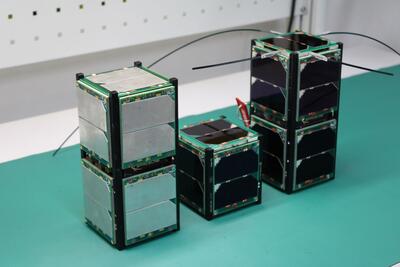
SpaceLab/UFSC opens opportunity to fly an experiment aboard a new satellite
SpaceLab is opening an opportunity for companies, laboratories, startups, and educational institutions interested in flying an experiment aboard the FloripaSat-RO satellite. The initiative aims to broaden access to the space environment for new partners, strengthening connections among different sectors of society.
Brazil in the Moon: initiative targets new launches and mission with SpaceX
SpaceLab is preparing for new satellite launches following the loss of two payloads during a previous launch attempt. The next mission is scheduled for the end of this year and will send nanosatellites into orbit in partnership with SpaceX.
LACW 2026 — Latin American CubeSat Workshop
UFSC hosts Latin America’s leading forum dedicated to research and development of small satellites.
Interview with Teacher Eduardo Bezerra
Watch the interview with our coordinator, Teacher Eduardo Bezerra, about SpaceLab and the Catarina Constellation. Published on the Brasil com Ciência YouTube channel.
Brazilian Space Agency officially adopts the Catarina Constellation in PNAE
The Brazilian Space Agency (AEB) has unanimously approved the official adoption of the Catarina Constellation, a mission involving SENAI Institute of Innovation in Embedded Systems, UFSC, MCTI, Civil Defense, and technical support from INPE.
To infinity and beyond: SpaceLab takes research at UFSC to another level
SpaceLab, responsible for launching the university’s first satellite into space in 2019, is part of the Catarina Constellation project, aiming to build Brazil’s first fleet of nanosatellites for territorial monitoring and climate emergency response.
CDR — Catarina
Meeting to review satellite project under development at UFSC. The Critical Design Review (CDR) took place April 11–12, 2024. Examination committee included representatives from AEB and INPE.
Ian Downie Final Year Project examination
Communications strategy for configuring nano-satellites activities scheduling. Supervisor: Prof. Eduardo Augusto Bezerra.
Guilherme dos Santos MSc results published
“Static Attitude Determination Using Convolutional Neural Networks” — MDPI Sensors. https://doi.org/10.3390/s21196419
FloripaSat-2 and Aldebaran-I structures are ready
Structures were fabricated by USIPED.
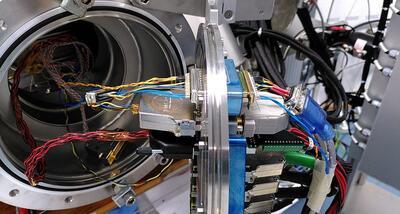
Payload-XL thermal vacuum tests
The thermal vacuum chamber at ESTEC pumped down. Payload-XL exposed to temperatures between -40°C to +65°C for 7 days, emulating orbit conditions.