Projects
R&D of unique, custom-built systems for space applications. From concept to final product, covering all Technology Readiness Levels.
Ongoing missions & projects
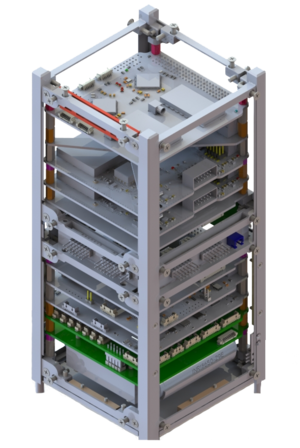
FloripaSat-2
1U / 2U CubeSat Constellation — 100% development — 1 YR missionThe FloripaSat-2 mission is composed of FloripaSat-2A and FloripaSat-2B, two nanosatellites developed under the FloripaSat-2 platform to validate a Brazilian CubeSat architecture created by SpaceLab. Each with its own power, processing, and communication subsystems operating in commercial frequency bands. Both satellites will be launched from the Alcântara Space Center (CLA) in the Spaceward 2025 mission, using a commercial launch vehicle called HANBIT-TLV by INNOSPACE, to place them into a low Earth orbit of 300 km.

GOLDS-UFSC
2U CubeSat Satellite — 100% development — 1 YR missionAn educational mission where students are involved with the design and operation of a CubeSat system in a space environment. Students learn about radio communications, digital communications, radio electronics, and antennas. An amateur radio mission will be implemented where the satellite functions as a digital store-and-forward repeater. The mission will have global coverage and be accessible to any radio amateur.
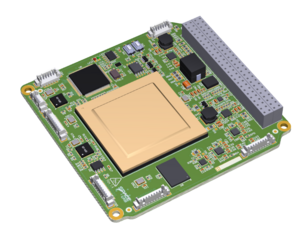
Payload-XL / GOMX-5
Rad-Hard FPGA Payload — 85% developmentPayload designed at SpaceLab, in partnership with ESA/ESTEC, for the GOMX-5 mission. GOMX-5 is a 12U satellite from GomSpace, Denmark. Payload-XL used the BRAVE NG-Large FPGA from NanoXplore, France.
Catarina Constellation
CubeSat Constellation — 90% developmentFloripaSat's bus to be used in the Catarina Constellation satellites under development at SpaceLab. Officially adopted by the Brazilian Space Agency (AEB) in the National Space Activities Program.
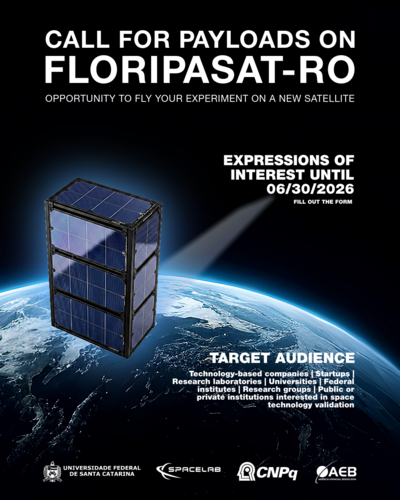
Microgravity-II
Sub-Orbital Launch — 70% developmentResearch and development of scientific payloads to be used in a sub-orbital flight campaign.
Past missions & projects
FloripaSat-1
1U CubeSat SatelliteSpaceLab's first satellite — four years of development, launched 20 December 2019 for a 12-month mission. “I'm made of metal…” Launch date: 20 December 2019. Mission lifetime: 12 months.
Serpens-I
3U CubeSat MissionThe Serpens-I mission was developed by UnB team, with the support of a consortium of universities, including UFSC.

Microgravity-I
Sub-orbital and ISS MissionsParticipation in the research and development of scientific payloads used in sub-orbital flights, and also on-board the International Space Station (ISS).
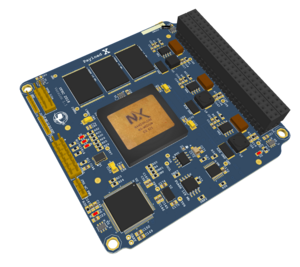
Payload-X
Rad-Hard FPGAPayload for CubeSats using the BRAVE rad-hard FPGA from NanoXplore, with institutional support from the European Space Agency (ESA).
Mission timeline
- Genesis of FloripaSat-1
- Microgravity program
- Serpens-I development
- FloripaSat-1 prototype
- First Engineering Model
- Serpens-I launch
- Second Engineering Model
- SpaceLab setup
- FloripaSat-1 Flight Model
- Payload-X proto-flight
- AIT & qualification
- Payload-XL development
- GOMX-5 with ESA & GomSpace
- FloripaSat-1 launch!
- FloripaSat-2 mission start
- Microgravity program
- FloripaSat-2 development
- Payload-XL · GOMX-5 launch
- Catarina Constellation
- More activities soon